
TLDR: Active Clubs are a white supremacist group using martial arts as a central organizational tool. Often characterized as decentralized, I argue there is an infrastructure in place enforced by cultural norms. I then outline an assessment to evaluate the role local club plays based on publicly available telegram chat logs and social posts.
Active Clubs are a network of white supremacists who focus on fitness and martial arts as a primary means of recruiting, engaging, and creating a “brotherhood”. Fitness and martial arts are also strategic pathways to ideal white supremacist activists. Strong, normalized to violence and capable, and filling the shoes of the “ideal”, superior race through hardened bodies and a clean cut cultural aesthetic.
A lot has already been written about what Active Clubs are. One of the best write ups comes from the Southern Poverty Law Center. It is not only in depth, but also covers the overlap between other nationalist groups and the international reach of Active Clubs. Importantly, the SPLC Hate Map also documents Active Clubs in each state. My goal here is not to duplicate this work, but rather to develop a club level specific assessment of the Active Club network.
A more localized approach adds an important layer to Active Club analysis. It demonstrates how Active Clubs influence each other, which active clubs appear to be more of a threat, and how the network evolves over time. With this information you can look at regional growth, who is the most influential groups in the network, and create escalation parameters to determine when groups are becoming more serious.
This model uses public communications (primarily Telegram, plus platforms like X, Gab, and Substack) to score five categories: ideology, language, organization/discipline, network role, and infrastructure, plus a sixth escalation score that reflects sustained movement across the other five. The intention is not to predict actions or measure propensity to violence, but rather assess infrastructure and shifts in club level communication around political extremism.
First, I will discuss Active Club infrastructure to demonstrate how Active Club culture is defined, and the movement is managed through defining in/out groups. Then I will introduce a methodology for assessing individual clubs, and ultimately will provide an Active Club scorecard for a sample of Active Clubs around the world.
Active Club Infrastructure
Active Clubs are commonly referred to as decentralized. Unrelated groups of young men following a vision and lifestyle outlined by Robert Rundo. If anything, this would be a hub and spoke model. In my view, neither of these two models are entirely accurate.
Active Clubs are not directly managed from a centralized source, or even regional hubs, but the tightly controlled cultural framework creates strong in/out group parameters. To belong, you must follow along. That indirect control places lots of influence within the hands of a few voices.
In practice this looks like a handful of sources communicating ideology, culture, and organization expectations, and the rest of the network adopted the espoused views and taking direction. These primary sources define and drive the entire network.
Core Ideology
A few sources, mostly directed connected to Rundo, define what it means to be in an Active Club. This is where the “in” group is defined, and Rundo exercises control over the network. If there is a centralized director of Active Clubs, this is where it exists. Here are the primary platforms and accounts driving the Active Club core ideology.
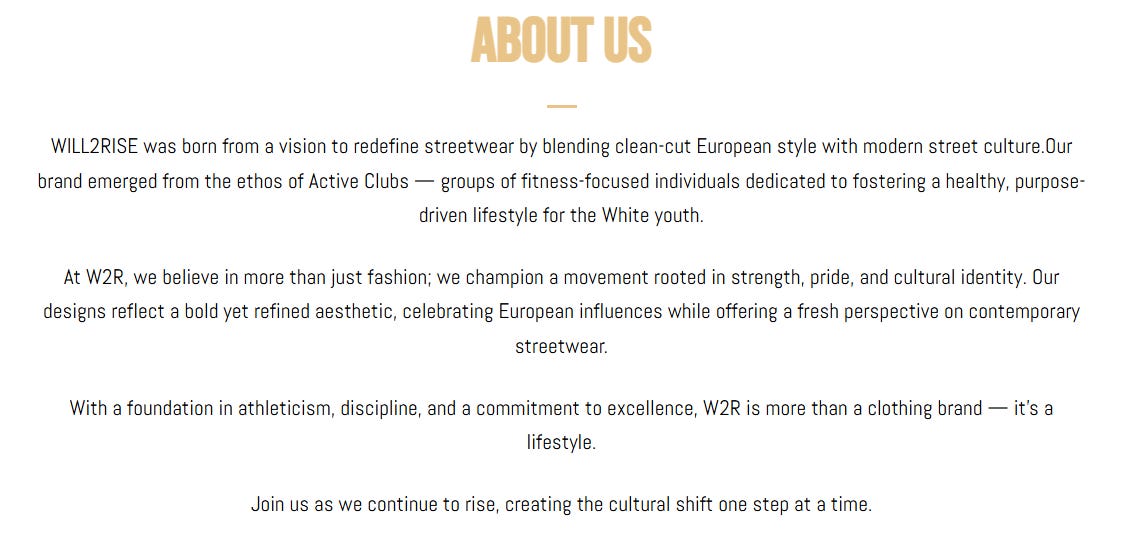
Will2Rise - Will2Rise is a lifestyle brand. It sells clothes, and more importantly defines an aesthetic. This is where identity framing begins. According to their about page, this aesthetic is about “a lifestyle”. Participating in Active Clubs isn’t just about white supremacy and fighting. Its about living by a specific code of conduct. This brand is the outward expression of that.
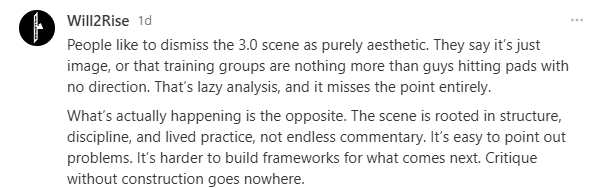
There is a Will2Rise Substack where the importance of lifestyle is stated explicitly. It’s an action that reflects commitment to the cause.
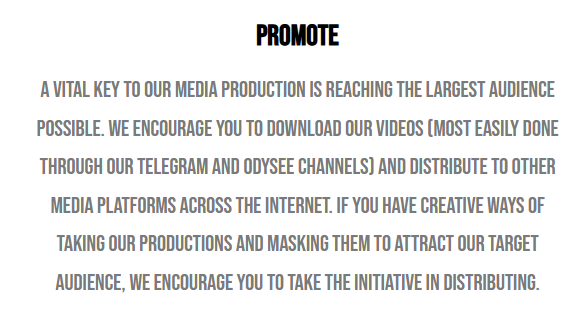
Media2Rise - Media2Rise is the propaganda arm of Active Clubs. It creates videos, pictures, and graphics meant to define Active Clubs and nationalism in a positive light. Active Clubs are not allowed to speak to the media directly. They are supposed to direct everyone to Media2Rise as the defacto propaganda arm of the group.
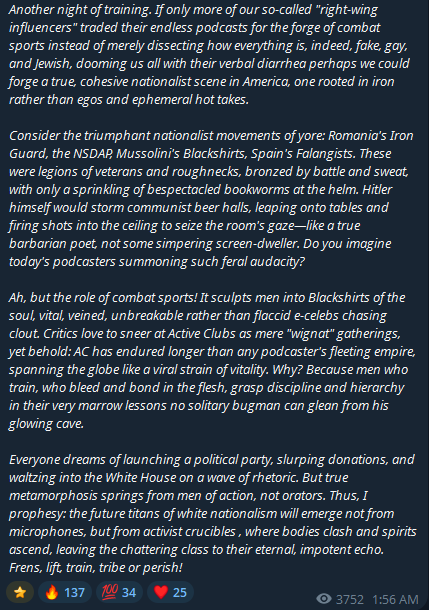
White Lads Aesthetics - White Lads Aesthetics is a social channel, and Telegram channel. It functions in the same way that Will2Rise does, and communicates cultural expectations and spreads Active Club propaganda.
Defining a lifestyle creates an “in” group, but also starts implementing hierarchy and infrastructure. Following the lifestyle is communicated as a commitment to the cause. Its a gateway action that leads people to greater actions. How can you fight for your culture, if you can’t follow the aesthetic? Its a simple test that draws a line between those committed and not, and also who is leading and following. If young men can’t take this simple direction, they can’t respect the hierarchy. This test is important. Conditioning for hierarchy is key to the Active Club strategy. The people behind these channels are at the top of that hierarchy.
Natural leadership - Local, Relay, and Core Nodes
With core ideology and identity being communicated from a handful of select channels, individual active clubs take on a series of roles in the organizations infrastructure. Here I will refer to each club as a “node”, as part of a social networking map.
There are three node levels defined here.
Local nodes - mostly small inward looking active clubs. They primarily consume ideology and work to fulfil the image. They do not create much original content, and mostly focus on things like fitness and community. These nodes are low barrier to entry for potential recruits, and are generally signs of expansion into new areas.
Relay nodes - active clubs that share lots of core ideology. They actively recruit and network with other clubs. Their significance is in their organization capacity and amplification effect. Relay nodes are generally older clubs, and have larger followings.
Core nodes - active clubs that produce ideological content, and contribute to identity forming. Often have direct relationship with Active Club founders like Rundo, and have a network wide influence. These clubs have earned a position within the network, and their communication is often shared.
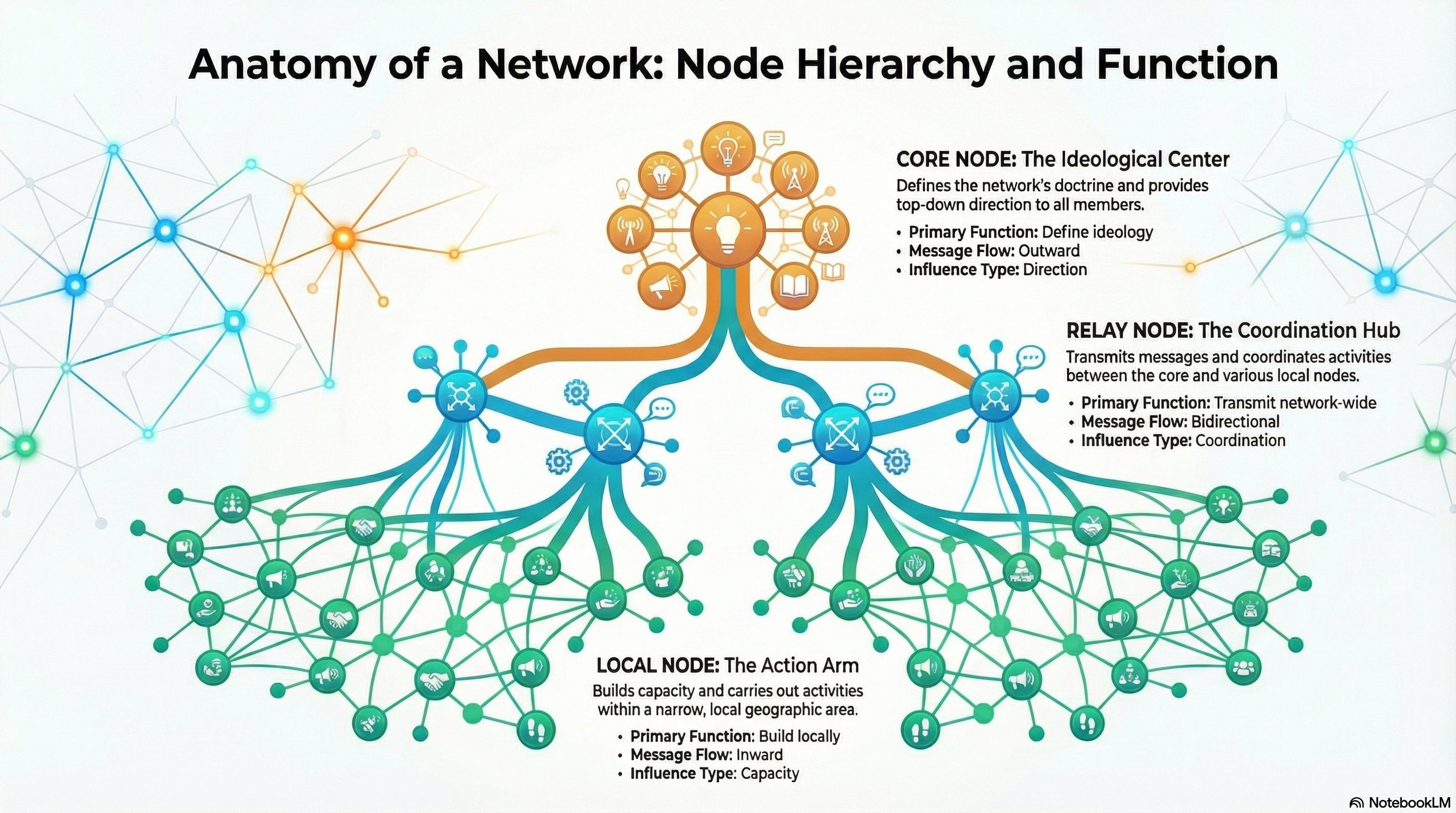
These three tiers of influence and extremism can be used to assess individual clubs, track their escalation over time, and identify any shifts within the Active Club network ideology. As an example, escalation behavior from a local node to a relay node would include sharing more core ideology, and networking with other active clubs and white supremacist groups. A trend of this behavior would change their tier from local to relay, and would signify an increased effort to expand the Active Club network.
The nature of these tiers creates an environment that is designed to let natural leaders emerge. This starts with creating a club, organizing training sessions, and “street activism” at a local level. Those that do this successfully demonstrate natural leadership within the movement, and is celebrated. Clubs that go further - more aggressive street action, club networking, pushing active club culture - they demonstrate increased commitment and emerge as leaders within the organization. Leaders can produce original indoctrination, that is then shared by other clubs.
This process is communicated fairly explicitly. The degree to which this network is decentralized is only within the context of explicit commands between individuals. The ideology, culture, and path toward leadership are defined by the channels distributing core ideology. People follow the given playbook, and are rewarded for their actions.
At risk of causing confusion, there are four tiers here. There are core ideological sources that are not necessarily Active Clubs, and then 3 tiers of Active Clubs (local, relay, core). There is some overlap in the word core, and that has some intention. Active Clubs can also function to produce core ideology. The distinction here is between people content producers with and without an Active Club.
Partnerships
Within the larger white supremacist community there is a push to create alliances. The Proud Boys, Patriot Front, Active Clubs, etc… have various differences in their goals, organization and intentions, but openly disregard these differences for the sake of unity. It is common to see multiple different organizations at meet ups, sharing each others propaganda, and defending each others behavior.
The Patriot Front specifically appears to have integrated into the Active Club network. Any region that does not have an established Active Club is referring people to join the Patriot Front. Communication channels from Patriot Front and Active Clubs consistently share each others media and there are regular incidents of live meet ups and training.
That said, there is an independent infrastructure and ideological source for these two groups. The Patriot Front has regional networks with their own top down leadership model, and joining each group has independent onboarding processes. For the sake of the assessment here, Patriot Front communication is not included.
Probation
To be included as an official Active Club requires a one year waiting period. Here is a portion of the Active Club “by-laws”:
• To be a recognized Active Club, you must have at least three members, if you have less than three members you are a probationary club under your closest recognized club. One representative must make it to one of the yearly events.
*Example, Frontier or other W2R sponsored events where more than three clubs gather.
• The club must put athletics before activism and politics. If the individual wishes to do political actions, it should be through one of our allied organizations.
• Promotional materials and videos should be focused on showcasing club growth, community and athletic prowess and should not showcase edgy political symbols from the past. We are a movement that’s focused on the future.
• All Active Clubs and their members are forbidden from giving interviews or talking to the media unless it’s Media2Rise or another approved outlet by (Appointed people.)
• Membership in Active Club requires a one-year probation period. Upon being accepted into a local Active Club, each full member has one vote on decisions, and majority vote cannot be overturned.
Rundo encourages anyone to mimic the Active Club model, so there are many groups of young men engaging in the Active Club blueprint. These groups are sharing the same information, and engaging in the same street activism as officially recognized Active Clubs.
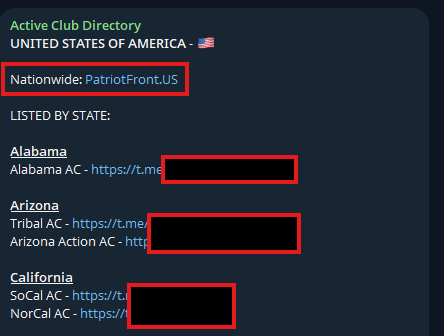
Most reporting on Active Clubs puts the official number of Active Clubs somewhere over 100, and this number is likely coming from the Active Club Directory Telegram channel screenshotted above. This channel has not been updated in over a year, and does not included many known Active Clubs. Realistically, when you include clubs engaging in the Active Club model and those on Probation, there are several hundred Active Clubs just in the United States.
The communication from these groups are included in this assessment, and are important to tracking and understanding the growth of the network. One of the goals with this assessment is to identify groups that are escalating their behavior by identifying them early, and tracking their potential ascension through the world of white supremacist influence.
Assessment Model
Creating a model to assess individual Active Clubs will identify where each groups fits within the Active Club infrastructure. Are they organizing and building a larger community? Are they creating original ideology that is shared, or just beginning to build a group of guys to train with? A model will also help track any changes in clubs behavior and influence.
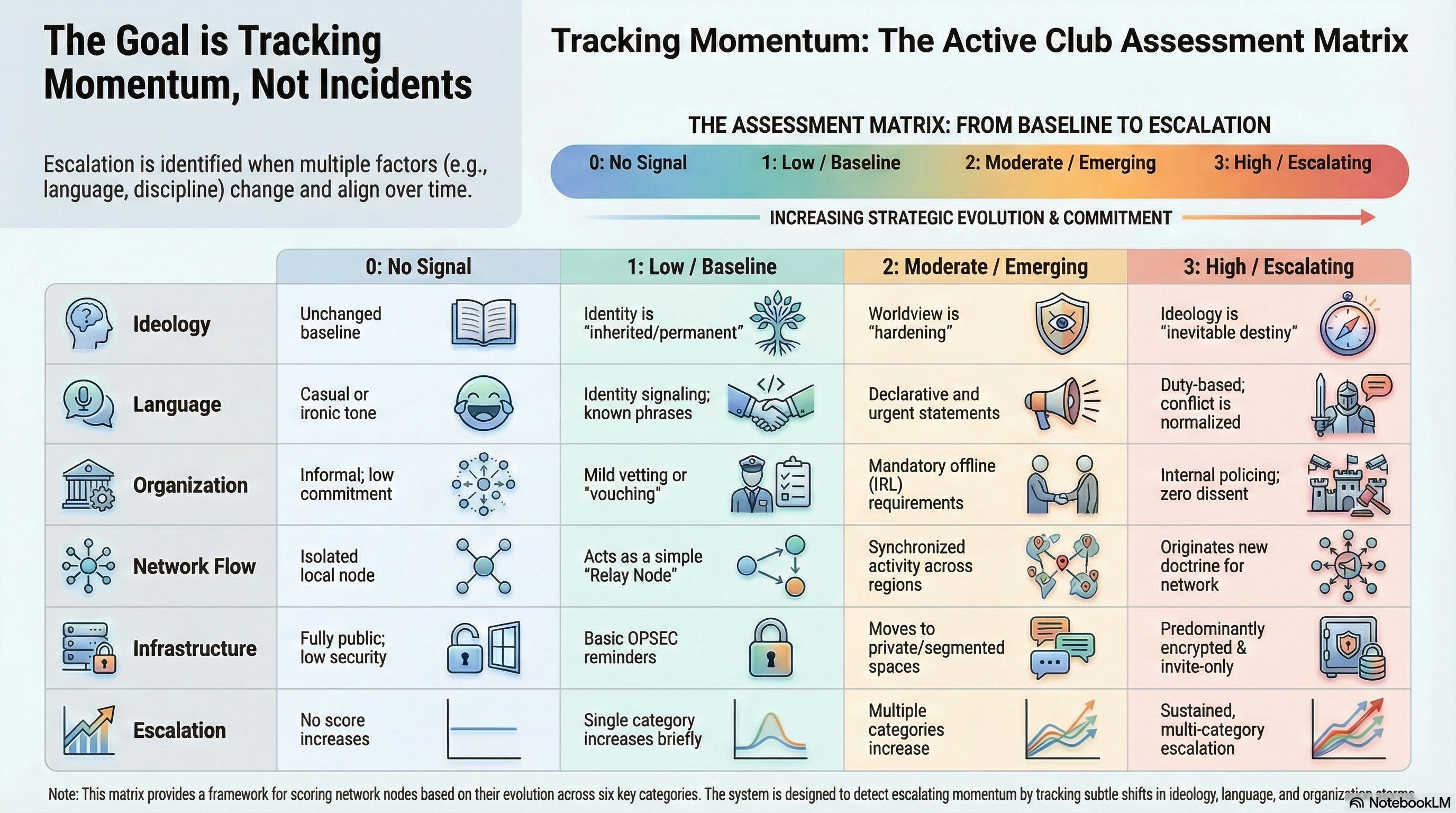
There are five categories that will be assessed based on public Active Club communication. The evaluation of each category will be given a numerical score, which allows for a scorecard. This will help quantify the assessment and make a comparison between clubs, and between moments in time. There is a 6th category that uses information from the other five to assess escalation.
Ideology
The first thing category being assessed is ideology, but not in the abstract sense of “what people say they believe.” This assessment looks at how ideology is used to define who belongs, who does not, and what obligations come with belonging. This is crucial to defining the in/out groups. In the Active Club network, ideology is communicated less through formal doctrine and more through lifestyle expectations, hierarchy, and identity framing. The question is whether white supremacy is treated as a loose affinity, or as a fixed identity that demands loyalty, discipline, and sacrifice. When ideology starts to function as a moral framework alone, that justifies exclusion, obedience, and escalation, it becomes a structural force rather than an opinion. You can find a longer breakdown in the Framework Explainer.
Scoring Assessment: Stability and direction of ideological framing
0 - No observable ideological framing or unchanged baseline
1 - Consistent ideological framing without intensification
2 - Hardening or increased integration with other categories
3 - Ideology framed as necessary, inevitable, or action-justifying
Language
Language is one of the clearest signals of how a group is evolving. Active Clubs rarely rely on explicit slurs or overt calls for violence. Instead, they use repeated phrases, euphemisms, and aesthetic language that normalize hierarchy, toughness, and inevitability. This assessment tracks how language changes over time: when irony gives way to seriousness, when metaphor becomes declaration, and when urgency replaces ambiguity. Repetition matters more than extremity. When the same framing shows up across multiple clubs, it signals coordination and shared influence, even without direct communication. It is common to utilize the same phrases, such as “tribe and train”. These phrases are effectively mottos for propaganda. You can read more about scoring language in the explainer.
Score assessment: Tone, certainty, and framing over time
0 - Casual, ironic, or ambiguous language
1 - Repetition of known phrases without shift
2 - Reduced ambiguity; more declarative or urgent language
3 - Duty based, inevitable, or conflict normalizing language
Organization and Discipline
Despite claims of decentralization, Active Clubs display clear forms of internal discipline. This assessment looks at how order is maintained without formal leadership structures. Probation periods, vetting, behavioral expectations, and rules around media interaction all function as mechanisms of control. Discipline is enforced socially rather than bureaucratically, through exclusion, praise, and status. Groups with stronger discipline tend to be smaller, more cohesive, and more durable. Over time, increasing discipline often correlates with increased risk, because it raises the cost of dissent and exit.
Scoring assessment: Commitment costs and internal enforcement
0 - Informal, low commitment, optional participation
1- Mild vetting or expectations
2 - Increased discipline, loyalty emphasis, or offline requirements
3 - Mandatory participation, internal policing, dissent intolerance
Network Role and Message Flow
Rather than asking who is “in charge,” this assessment tracks how influence moves. Some clubs are inward-facing and primarily focused on local training and community. Others act as relays, amplifying ideology and culture between regions. A small number function as core nodes, producing framing and identity cues that spread across the network. By observing which clubs are sharing content, how quickly messages propagate, and where language originates, it becomes possible to see coordination without assuming centralized command. Shifts in network role, especially from local to relay, are key escalation indicators.
Score assessment: Role, influence, and coordination patterns
0 - Isolated or inward-facing node
1 - Consistent forwarding or limited relay behavior
2 - Increased synchronization or bridge behavior
3 - Origination of framing, rapid diffusion, cross-regional coordination
Internal Infrastructure
Internal infrastructure refers to the systems that allow Active Clubs to persist under pressure. This includes platform redundancy, private communication channels, physical training spaces, branding consistency, and recruitment. Infrastructure is less about sophistication and more about resilience. Groups with stronger infrastructure can lose accounts, face scrutiny, or fragment publicly while continuing to function internally. Social accounts associated with Active Clubs have a history of being deplatformed by the major social media channels. This has led them to strategically focus on platforms such as Telegram and Odysee, and direct their audience to back up channels. Physical spaces like gyms and training groups are especially important, because they turn ideology into routine behavior and make the movement harder to disrupt.
Score assessment: Communication practices and visibility
0 - Fully public, low OPSEC awareness
1 - Initial OPSEC reminders or platform diversification
2 - Migration to private or segmented spaces
3 - Predominantly private, encrypted, or invite-only coordination
Escalation Signals
Escalation is not treated as a single moment, but as a trend. This assessment looks for gradual alignment across categories: harder language, tighter discipline, increased coordination, and reduced public visibility. Early warning signs include faster message synchronization, rising expectations of commitment, and shifts from symbolic participation to preparatory behavior. No single post triggers an escalation score. What matters is direction over time.
Scoring assessment: Direction, duration, and distribution of change
0 - No upward movement
1 - Single-category increase or short-lived shift
2 - Multiple categories increasing within one period
3 - Sustained multi-category escalation or tier drift
Escalation Logic
When we talk about escalation, we are not pointing to single posts, dramatic language, or moments of outrage. Escalation is a process that unfolds over time. It shows up in small, often quiet shifts that begin to align: language becomes more certain, expectations on members increase, coordination tightens, and responses to events happen faster and more uniformly. None of these changes matter much on their own. What matters is when several of them move in the same direction and stay there. This framework looks for patterns, not predictions. It tracks sustained movement across behavior, communication, and organization to understand when a group is becoming more disciplined, more coordinated, and more capable, not to guess what it will do next, but to recognize when risk is increasing.
Why These Categories Matter Together
None of these areas are assessed in isolation. A club with extreme language but weak organization is less concerning than one with moderate language and strong discipline, infrastructure, and network ties. The goal of this assessment is to understand capacity and trajectory, not to react to noise. When ideology, language, organization, network role, and infrastructure begin reinforcing each other, escalation becomes more likely, even if nothing dramatic has happened yet. In the initial assessment it is clear that these categories move together.
The Challenges
There are challenges and drawbacks in this work. I intend on stating them openly to help improve the model with public feedback, and help put the model into perspective.
This work heavily relies on Telegram chat logs, which is the primary social platform for Active Clubs, but also draws on other social media including X, Gab, and Substack. The scale of data is not equal. Some chat logs have years of history, and some less than a year. Chat logs with less data will provide less reliable assessments. What this is assessing is public communication. Clearly, this could be disjointed from real world action and intentions.
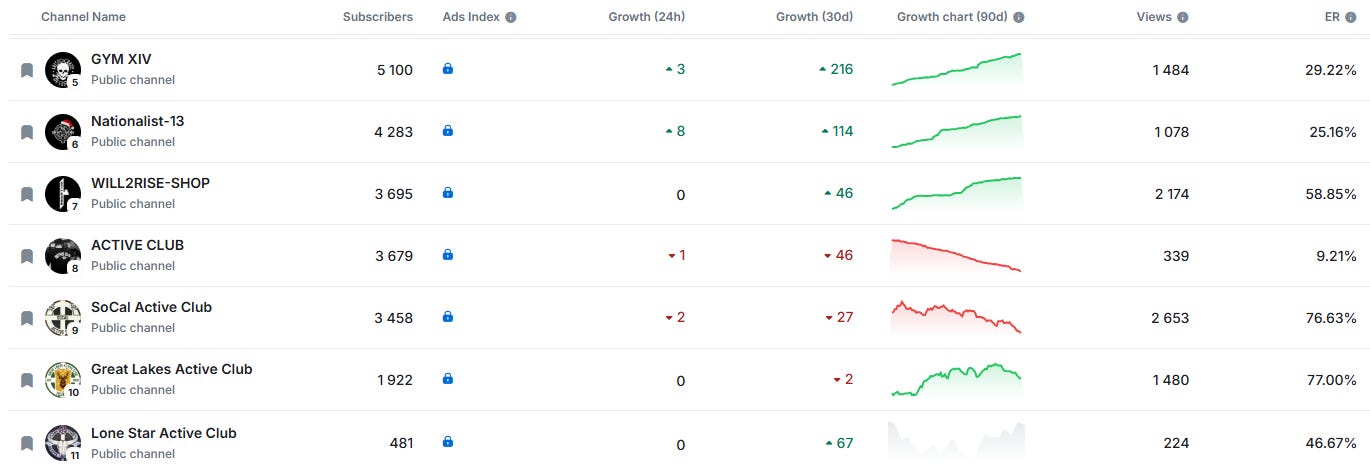
The multitude of channels involved in communicating the Active Club ideology and lifestyle is a strategy. It disperses accountability, and “floods the zone” of white supremacy sub culture. It also makes it difficult to assess overall social growth and impact. Notably, follower counts are not included in the assessment. As an example, you can see from the telegram channels noted below that some accounts are growing, some are shrinking, and there are various levels of engagement in each channel.
There is also an Active Clubs access problem by default. Their belief system pushes people offline. They would rather meet up with 5 people in private, than have a large social following that isn’t committed to action. Active Clubs also have rules around what they can post publicly. They generally do no post explicitly racist content, and are directed to not post much about politics. These dynamics minimize and skew their true ideology, and is why looking at lots of data over a long time period helps to paint a clearer picture.
A rubric for assessment creates objectivity and an ability to evaluate changes over time. It will take multiple assessments to determine what needs to be corrected in the model.
The Scorecard
With a system to evaluate in place, a scorecard can be developed to assess each club. Based on total scoring they can be placed into one of the tiers discusses above.
Tier 0 - Core ideological sources.
Tier 1 - Local node. Scores from 0-7
Tier 2 - Relay node. Score from 8-12
Tier 3 - Core node. Score from 13-18
As the first assessment, the below will be considered as the baseline. For this baseline chat logs were used from the inception of a channel to early January 2026.
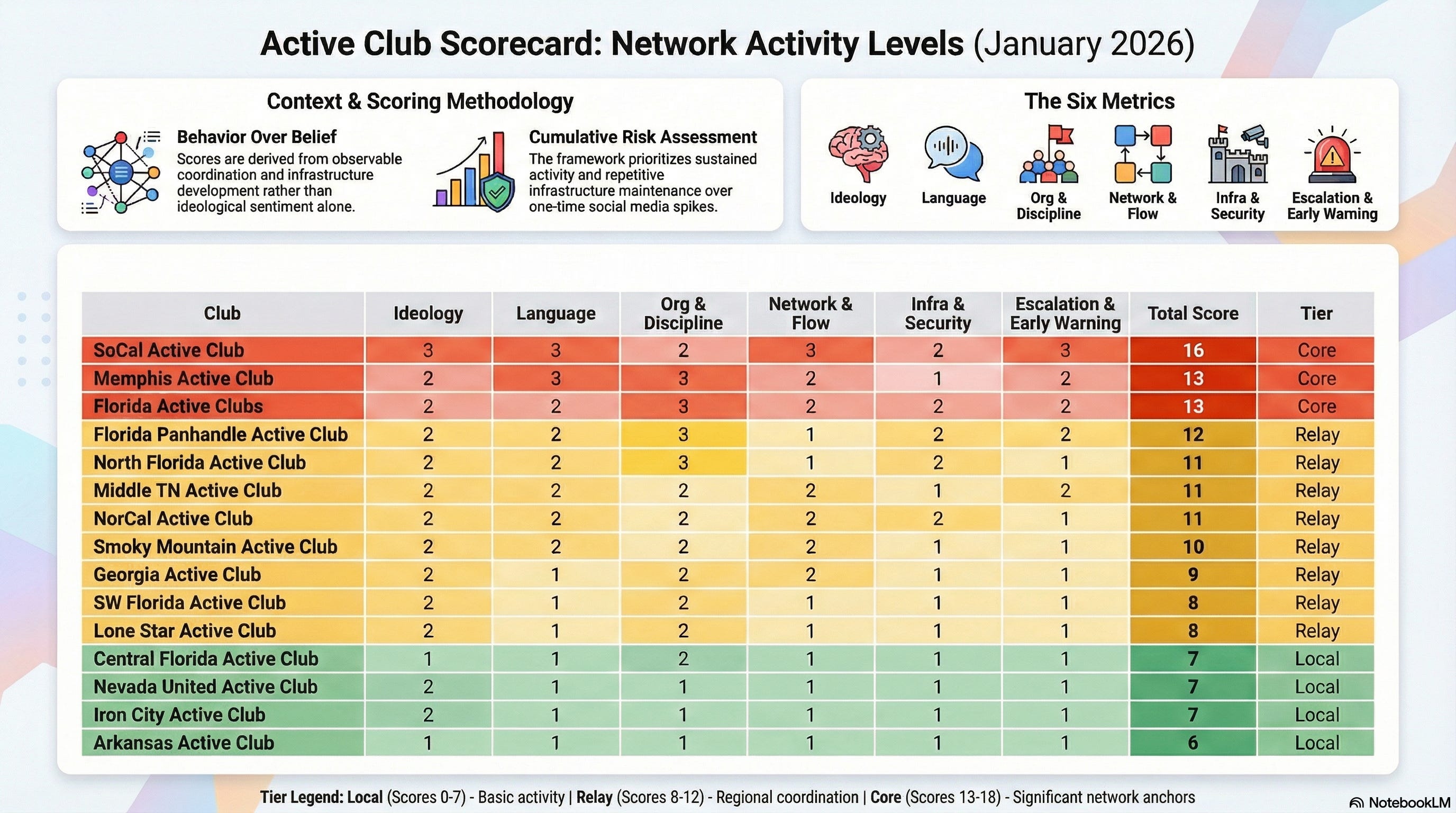
These were clubs chosen at random, and reflect a wide range of ideological alignment and threat. You can see that escalation typically happens across all categories, reflecting general consistency in how these groups behave online.
Pressure Testing
Once a scorecard is complete, you can go back and evaluate the overall picture with what’s happening in the channels. You would expect scores that are fairly close together to reflect similar communication, and large disparities to have a noticeable difference in communication. Its important to remember, this is not just about content, but a pattern of content. All of these groups espouse white supremacy.
Taking the top and bottom clubs as an example, you can see a difference in the top of communication that is being shared.
SoCal Active Club
The SoCal Active Club has one of the larger followings on Telegram. They consistently network and bring different organizations together.
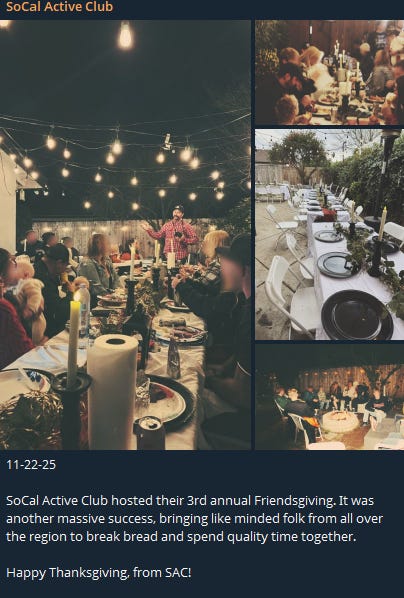
Most Active Club communication channels don’t post much original content. Its usually forwarded messages from core ideological sources. The SoCal Active Club is one of the few that consistently posts their own content. How often this content is shared is also a reflection of how influential a specific Active Club is.
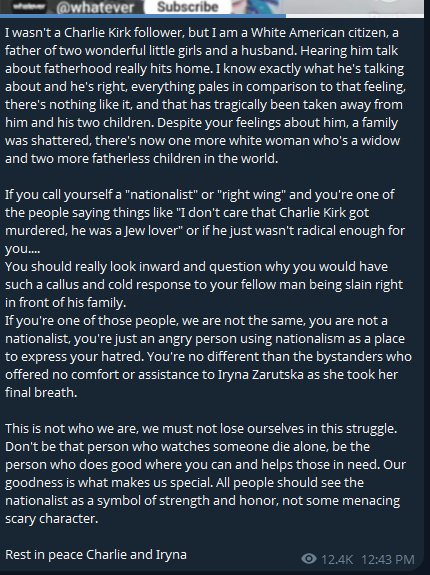
Frontier Combat is an Active Club MMA event. SoCal Active Club hosted this event, showing their networking and influence capacity. Showing up to these events is strongly encouraged. Showing up at some sort of meet up is required to be considered an official Active Club. The Patriot Front integration with these events is notable.
Arkansas Active Club
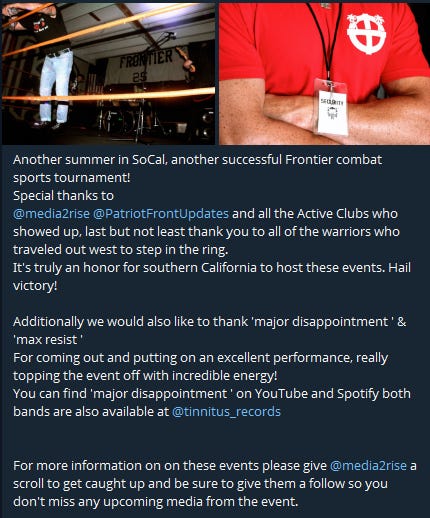
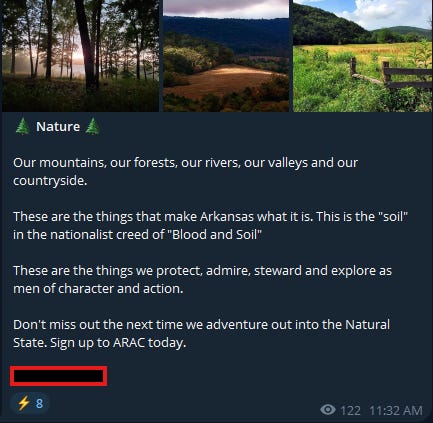
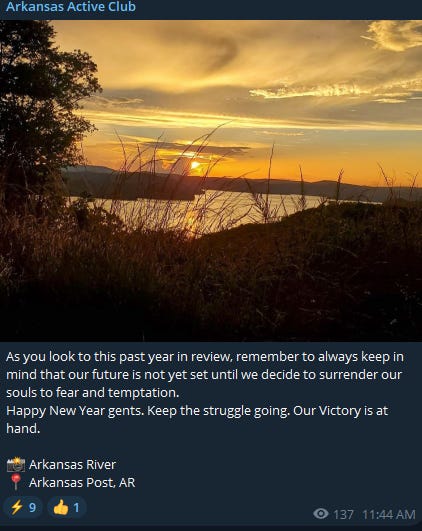
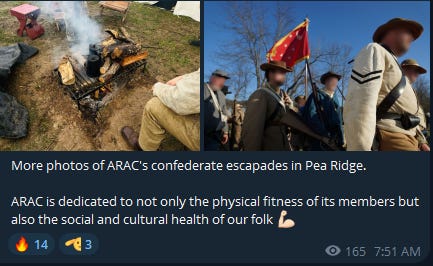
The Arkansas Active Club was the lowest scored Active Club in our ratings here. The Arkansas Active Club shares a lot of the same messaging from core ideological sources, but leans into fitness and community. It also has a much smaller following. Messaging is more inward facing, and designed for recruitment over networking. Original content posted general copies common white supremacist tropes, such as “blood and soil”.
Assessment
The overall characterization of these Active Clubs is consistent with the scoring rubric. With each run the model will be updated to create the most accurate and consistent scoring possible. The true value of this assessment will materialize once there are multiple assessments done over a long time period. This assessment will be ran quarterly.
Further Explainers
More in depth explanations of each scoring category can be found here:
This is for research, risk understanding, and early warning, not doxing, harassment, or vigilantism.
Only public material is used; private identities are not published unless already credibly reported.
Do you have direct information regarding Active Clubs, or other extremist groups? Contact me at SubmittingDisinformation@protonmail.com
Have you interacted with the Nation of Islam or Black Hebrew Israelites before? The active clubs seem to be doing the same for white working class youth who are also vulnerable to crime.
I have no horse in this race because I’m neither black or white, and my people are ascendant in this country with higher incomes than both black and white people. But you should really think about the social role that they play and try to create something that you think its better for them.