Framework Explainer: Internal Infrastructure
How the Active Club Assessment analyses and score internal infrastructure

Primer: The Active Club Assessment is designed to evaluate individual Active Clubs against a scoring rubric. There are 5 main categories in the rubric, collectively representing the degree of organizational maturity and ideological intensity. I outlined the full framework here. In this article I will further explain how internal infrastructure is scored in the assessment.
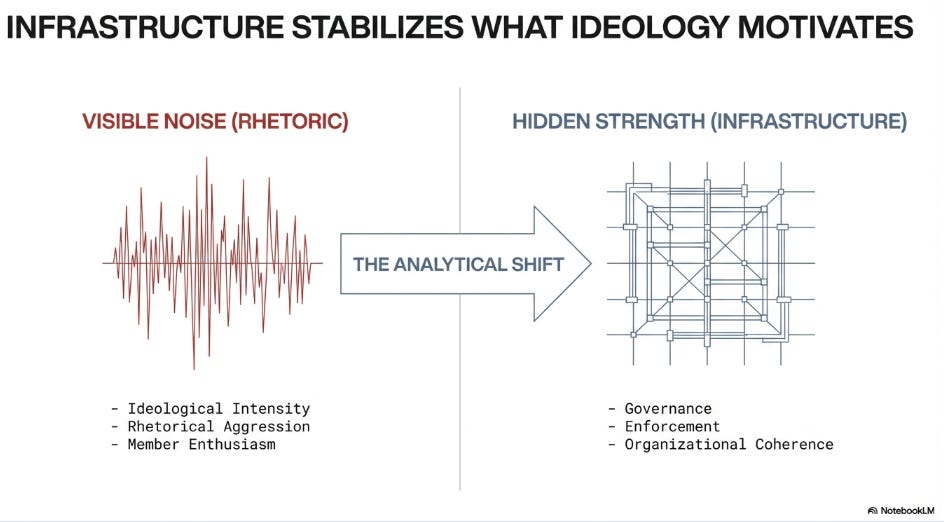
Active Club Internal Infrastructure
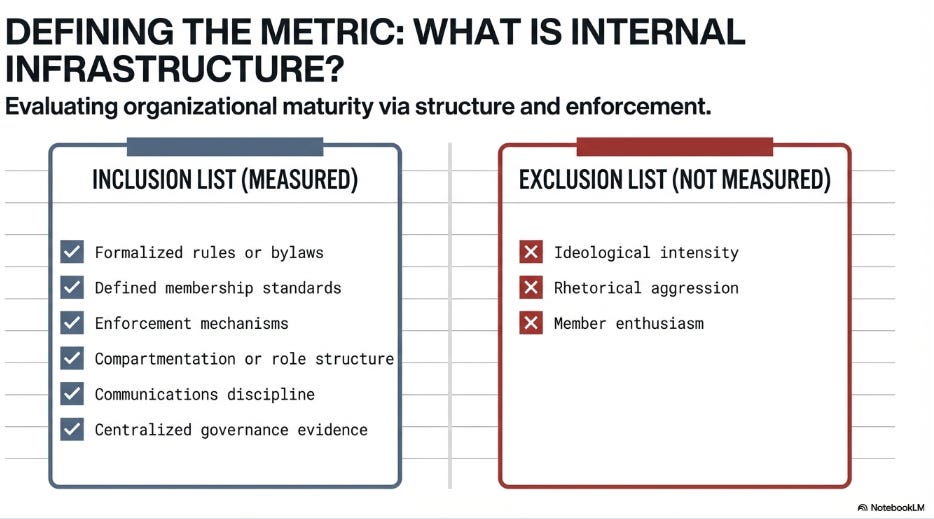
Internal infrastructure measures the formal systems that allow a club to operate, reproduce itself, and enforce standards over time. In short, structure and enforcement mechanisms. Internal infrastructure is what allows Active Clubs to sustain themselves over a long time, and survive against deplatforming, doxing, and social pressure. Evidence of infrastructure includes:
Formalized rules or bylaws
Defined membership standards
Enforcement mechanisms
Role structure
Communications discipline
Evidence of centralized governance
Internal infrastructure looks at how these criteria are outlined on paper. How well people follow the criteria is more related to the organizational discipline category.
Infrastructure asks: Do the rules exist?
Discipline asks: Are the rules followed?
The existence of rules is what transitions Active Clubs from a social club to an institution. Institutions will outlast individual members and leaders.
Elements of Infrastructure
There are some core elements of Active Club infrastructure, many of which are outlined in the Active Club by laws. The by laws are referenced throughout Active Club communication. To be considered an “official” Active Club, you have to abide by the by laws and go through a one year probationary period.
The by laws are noted below. One note, these were taken from within a local clubs channel, and not from a core ideological source such the telegram channels Active Club Official, White Lads Aesthetics, or Will2Rise. There may be some variance in this information from other clubs.
Active Club manifesto, by laws, and club commitments:
Active Club definition: Group of White men who train for combat sports and general athletics to compete against other active clubs.
Active Club Manifesto
The main purpose of the Active Club model is to bring white men together to build community and to build health (mental/physical.) We aim to affect the culture by building our own, one that builds a better man through tapping into our competitive nature, not through violence or intimidation of the public. We are an athletic group focused on bettering our people, not meddling with, or hurting other people(s).
Active Club By-laws
• To be a recognized Active Club, you must have at least three members, if you have less than three members you are a probationary club under your closest recognized club. One representative must make it to one of the yearly events.
*Example, Frontier or other W2R sponsored events where more than three clubs gather.
• The club must put athletics before activism and politics. If the individual wishes to do political actions, it should be through one of our allied organizations.
• Promotional materials and videos should be focused on showcasing club growth, community and athletic prowess and should not showcase edgy political symbols from the past. We are a movement that’s focused on the future.
• All Active Clubs and their members are forbidden from giving interviews or talking to the media unless it’s Media2Rise or another approved outlet by (Appointed people.)
• Membership in Active Club requires a one-year probation period. Upon being accepted into a local Active Club, each full member has one vote on decisions, and majority vote cannot be overturned.
Member commitments to the Club:
• You must be drug free.
• You must be heterosexual.
• You must not commit crimes in the name of the club. The moment a member commits an illegal act their membership is revoked, rather it’s made known or not.
• You must lead an honorable lifestyle and have no past of child abuse or sexual crimes.
The Rulebook
The above outlines an Active Club rulebook, vetting process, and power structure (voting rules). Active Clubs are often characterized as decentralized. One of the goals of the Active Club assessment is to develop a sense of structure within the network. This documented structure is inherently hierarchical. Who defines the rules? Who assesses the clubs on probation? Who tracks who has been to annual events? It reflects a level or organization and accountability that speaks the broader structure of the network, and lends toward a centralized structure.
For local clubs, those that follow the rulebook are recognized. Enforcement includes exclusion from the Active Club network, and is referenced throughout communication. The presence of, and referencing to, of these written rules is evidence of structural maturity. There are some key elements of the rulebook, including communication in addition to the above by laws provide what amounts to a protection plan.
Codified governance - formalized procedures and standards set in place for Active Clubs
Enforcement mechanism - clubs will purge members that don’t follow the rules or create legal jeopardy.
Leadership deference - local clubs follow the Active Club playbook. They communicate the same language, engage in the same behavior, and are expected to follow direction from leadership. Mainly, Robert Rundo.
Action cadence - groups are expected to train with each other at regular intervals, engage in street activism, and participate in annual meet ups.
Digital resilience - this is very important to the Active Club network. They largely focus on Telegram, but are increasingly growing on X. They create back up channels in case they are deplatformed. They outline rules to avoid being doxed and only talk about information security.
The below is manual that was been floating around Active Club channels. There is a lot of information here, and I chose to include it all because it highlights the maturity of their infrastructure.
Active Club OPSEC
MODERN DISSIDENT OPSEC MANUAL (M-DOM)
Doxxers (Antifa scrapers, FBI informants) target Active Club channels hard via Telegram forwards, Gab posts, and rally footage. Focus on collective anonymity: No lone wolves shine.
Posting Photos/Videos Online (Training, Hikes, Events)
1. Metadata Purge + Video Scrub:
EXIFTool or FFmpeg for videos to nuke GPS, timestamps, device IDs. Strip audio tracks if voices could ID accents/dialects. Compress to <720p; low-res breaks AI frame analysis.
2. Group Anonymization Rules:
- Faces: Blur or pixelate all faces (Photopea or DaVinci Resolve free tiers). Use black bars over eyes/noses for stills. In videos, wide shots only—no close-ups (unless blurred). Test with PimEyes or Hive Moderation API.
- Bodies/Builds: Athletic physiques are fingerprints. Crop torsos, use shadows/lighting tricks, or overlay club logos strategically. No visible scars, tattoos, or unique ink (cover in real life too).
- Gear/Props: No Active Club shirts/hoodies/patches in media—use generic athletic wear (black shorts, plain tees). Rotate sponsor-free equipment. Blur plates on cars/vans in parking lots.
3. Background Blackout:
- Train in rotating rural spots: State parks, abandoned lots, private farms (ally-owned). No urban gyms with signage.
- Avoid repeats: Post from Site A once/month max. Use Google Earth to vet for unique landmarks.
4. Channel Discipline:
- Post from club-wide burners on Telegram (private channels, auto-delete after 24h) or Gab anon accounts. VPN/Tor mandatory; Proton Drive for storage.
- Pseudonyms only: No real handles, bios, or location tags.
- Cadence: Irregular drops, 1-2/week. Forward-ban outsiders.
5. Leak Testing:
Run club media through Maltego/OSINT Framework as a team drill. Simulate doxxer chains: Image → geoloc → property records → voter rolls.
Being Out in Public (Meets, Training, Rallies)
1. Gray Pack Tactics:
Uniform blandness—cargo pants, hoodies, ballcaps (no logos). Match local normies: Jeans + polos for urban meets. Change kits post-session.
2. Biometric Evasion:
- Faces: Balaclavas/ski masks for training (call it “cold weather prep”). Sunglasses + beards/hats in public. Shave heads or grow out weekly.
- Groups: Operate in small cells; stagger arrivals/departures.
- Phones: Burner flips (cash, no SIM trace) or Faraday bags. Airplane mode + no pics during ops (outside of designated photographer).
3. Mobility and Routines:
- Vehicles: Shared unmarked vans (rented cash/crypto, rotated). Park offsite, walk in. No personal rides.
- Events: Foot/bike only in contested areas. Vary routes via apps like OsmAnd (offline maps). Scout cams with Wardriving apps.
- Training: Dawn/dusk sessions in low-pop zones. Private land priority—network with landowners for access.
4. Event Protocols:
- Rallies/Protests: Flankers only; no center-stage. Masks standard. Extract via pre-planned rally points (e.g., 10min post-event scatter).
- Post-Op: Immediate gear swap at safe houses. BleachBit devices, ditch SIMs.
- Ally Vetting: New joins under 90-day probation—no compromising access, observed only.
5. Counter-Intel:
- Weekly audits: Check club for infiltrators (behavioral red flags: Pushing photos, asking home addresses).
- Alerts: Group Google Alerts for “Active Club [city]”, Have I Been Pwned rotations.
- Comms: Signal/Element end-to-end, disappearing messages. No texts about meets.
Club-Wide Mandates
- Oath Integration: Make OPSEC a core tenet—breaches = boot. Train it like Brazilian Jiu-Jitsu: Reps build muscle memory.
- Tool Stack: Tails USBs for uploads, VeraCrypt volumes per cell, Mullvad VPN accounts (shared but rotated).
- Mindset: You’re building parallel strength for the future—doxxers are the enemy’s scouts. Discipline wins wars.
Run this tight, brothers, and you stay ghosts pushing back. Adapt to local threats.
Hail Victory!
The more presence of these types of guides and rulebooks, the stronger the internal infrastructure.
It’s important to note that these are posted publicly, and contains built in disclaimers. For example, comments that specifically reference never breaking the law are not consistent with other communication within these groups. These are strategic disclaimers for legal reasons.
Scoring Internal Infrastructure
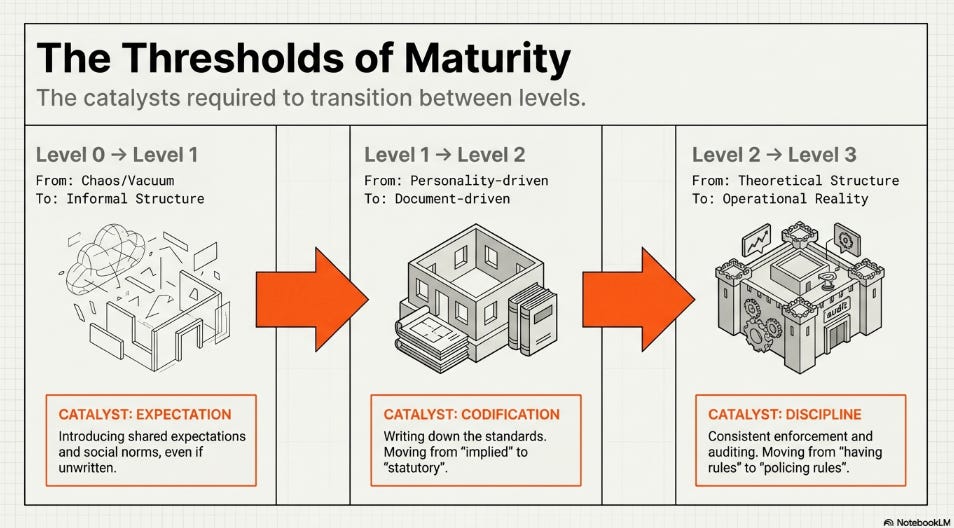
Scoring internal infrastructure is a process of evaluating formal structures communicated within the group. More well thought out procedures and evidence of enforcement would result in a higher score.
A score of zero: No meaningful internal infrastructure. No posted by laws, membership process, or recognition structure. Purely social and loosely organized structure.
A score of one: Emerging or informal infrastructure. Some basic structure appears to exist, but is limited and and inconsistently referenced. This appears as implied rules, and structure dependent on personalities vs systems.
A score of two: Clear governance mechanisms are visible and in use. By laws and formal standards are communicated. Membership expectations are stated explicitly, and member exclusion is communicated as enforcement. There is alignment with the broader active club infrastructure. Here there are signs of broader coordination with other clubs and leaders.
A score of three: A mature infrastructure exists, and is enforced. Standards and enforcement actions are communicated. There appears to be a clear leadership or role structure. There is alignment across different clubs, with centralized standards. Standards are driven more by process that personality.
Sustainability
Internal infrastructure is ultimately about institutional survival. When rules are codified, enforcement is normalized, and governance is embedded in process rather than personality, a group becomes resilient. Ideology may inspire participation. Language may normalize it. But infrastructure determines whether the organization endures.
Have information about extremist groups in martial arts? Contact me at SubmittingDisinfo@Protonmail.com