The Trigger and the Martyr
Glorious Pasts, Dystopian Futures, and the Search for a Trigger

The challenge with dissecting complex topics is narrative drift. As pieces are pulled together they must be explained. The person on the scene of the crime must be relevant, but how? The back story takes us somewhere else. Writing in complexity is about contending with this drift. Where do I go? How much time do I have? How much time do my readers have?
I’ve been stuck in this battle all morning, just to set up a story I already know how to tell. I’ve told it before, at least versions of it. On February 12th a man was murdered in Lyon, France. There is lots of complexity to this story. Anti immigrant feminists, Palestinian activists, a city with a history of partisan violence. I’m going to set a scene with simplicity. Not to negate the power of these complex stories, but to tell the one I think needs to be told. To stop contending, and to start posting.
Complexity pulls in every direction. Propaganda does the opposite. It simplifies. The far right thrives on this simplification. It’s narrative architecture is almost always the same.
The far right uses a simple narrative structure. I’ve written about this before, and is apart of my Active Club assessment framework. The TLDR is this: The far right uses a three part act.
Define an exclusive, glorious past
Paint a dystopian future of oppression
Define an urgency in the present, to act now before it’s too late.
You can see this narrative everywhere, as I will outline more in a moment. There is a fourth aspect to this narrative, that is the ideal white supremacist society. That dystopian future will change if white supremacist groups act now. That sense of urgency in the present is important. It’s always telling a story that urges action. What triggers this action?
First, we need to set the scene of conflict. This structure isn’t theoretical. It is unfolding in real time, and we have a case study that demonstrates how triggers are used to incite the right.
Streets of Conflict
A protest, a fight, and a death on a university campus in Lyon. A man, Quentin Deranque, was fatally injured during a street brawl in Lyon France on Feb 12th. Deranque was affiliated with far right street networks and had previously participated in confrontations with antifascist groups. These groups were brought together by protest. Palestinian causes. Anti immigrant feminists. It’s a lot to dissect, and lots of narrative drift to box out.
The Nemesis Collective, an anti immigrant far right women’s group in France, went to the Lyon Institute of Political Studies to protest a French Palestinian speaker, Rima Hassan, objecting to her public positions on immigration and Palestine. Hassan is a member of parliament and works to support Palestinian causes. The Nemesis Collective was supported by a group of far right men, who said they were providing security to the women. The optics were deliberate: women framed as vulnerable, men framed as protectors.
This protest was met by leftist groups, including the Antifascist Young Guard. Fights broke out. Street brawls involving handfuls of men. There is a history of this in Lyon. One of those brawls resulted in a group of men pummeling 3 individuals into the concrete. One of those individuals was Quentin Derangue. He was able to leave the scene, but died two days later from head injuries. Within hours the death was reframed.
Quentin is the trigger, and the martyr. This is where individual tragedy becomes narrative fuel, and a street fight became a story.
The Narrative
The three part narrative mentioned above has a long history. It’s used by extremist groups and major political parties. Clearly, it works, and is easy to follow. Once you understand the narrative you can spot it everywhere. Sometimes it is all displayed in a neat package, sometimes you only see one aspect of it. Spotting it is one of the easiest ways to recognize far right propaganda.
The glorious past is about justification. Greek philosophy, Roman empire, Pagan spirituality. Whatever it is, it’s greatness exceeds the present and it’s story is tied to white identity. These two points are all that matter. Certainly more than historical accuracy, which is often lacking. This historical white excellence is used as justification for white supremacy. The thinking goes, no one is greater than this, therefor we have a right to maintain this greatness. If this sounds vague, it’s because it is. It’s meant to be. The myth making is strategically slippery.
The dystopian future has a lot of variations, and they all include oppression of white people. Rights are stripped. Other races and race traitors are at the helm, coming for you. You will lose your freedom, your culture, and your family if you let this dystopian future come to fruition.
The urgent present is about this tension. The past is glorious. The future is bleak. They can regain greatness if only they act. If not, surely the dystopian future will become reality.
They are always searching for a confirmation. Signs that the oppression is here. That the battle against whiteness is now upon us. These are the triggers. Events white supremacist propaganda point to to confirm the narrative. Migration. Crime by immigrants. Changing population demographics. Extremist groups are constantly pointing to these things to confirm the dystopian future is upon us.
Unless they act. The trigger is supposed to be a call to action. The fourth component of the narrative, an ideal white society, will only come if white people are willing to fight. “Fighting” looks differently depending on the brand of racist. The most extreme version is race war. Take up arms and go to war against every institution that supports diversity. Other versions are slow, multigenerational efforts to build exclusive white communities.
Narrative Patterns
This narrative has a long history, and is used across the right. We see it in American politics. We see it in racist literature, and extremists groups recruiting right now. The narrative pattern is important to understand, because then you see how these groups are connected. The GOP speaks the same language as the most extreme white supremacists. They operate within the same narrative architecture. Let me provide some receipts.
The Turner Diaries
The Turner Diaries is a novel written in 1978 by William Peirce, the founder of the white supremacist group National Alliance. The book has been referred to as “the bible” of white supremacy. It has created inspiration for generations of anti government white supremacists. As an example, the Oklahoma City bomber, Timothy McVeigh, owned the book and the bombing mimicked an attack from the book.
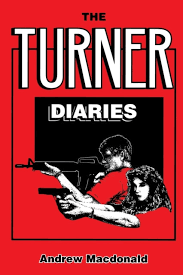
The Turner Diaries doesn’t describe a detailed past, but does allude to a better past in America, where some sort of white homogeneity seemingly existed. This is all it really takes, a sense that if we act we can make things like they use to be. Making America great again, so to speak.
The trigger in the Turner Diaries is much more clear. America has already begun turning towards oppressive policies, and is controlled by Jews. The final straw is the forced confiscation of guns, which radicalizes the main character, Earl Turner. Turner then joins “The Organization”, an underground insurgency group that leads a civil war. Ultimately, this war goes global. The Organization seizes nuclear weapons and drops nukes on cities, attempting to kill non white populations. Dark stuff.
The Dystopian future in this tale has already arrived. The trigger, gun confiscation, causes a war that brings an alternative white society. It’s a narrative that fits the pattern, and has inspired thousands of white supremacists around the world. It’s effective narrative structure has been proven, and copied. What began as extremist fiction has become a governing narrative style.
Kirk
Unless you spent all your free time tracking down right wing extremist groups, you probably never heard of Charlie Kirk before he was assassinated. If you did, he was probably viewed as just another right wing influencer, like a Ben Shapiro. But Charlie Kirk ran a massive multi million dollar operation. He focused on the youth, high school and college kids around the country, and pushed them toward conservative politics. This push has played a major role in the shift of young men in the US toward holding right wing political beliefs. He was a racist and unapologetic Christian Nationalist, and a generation of young men followed suit.
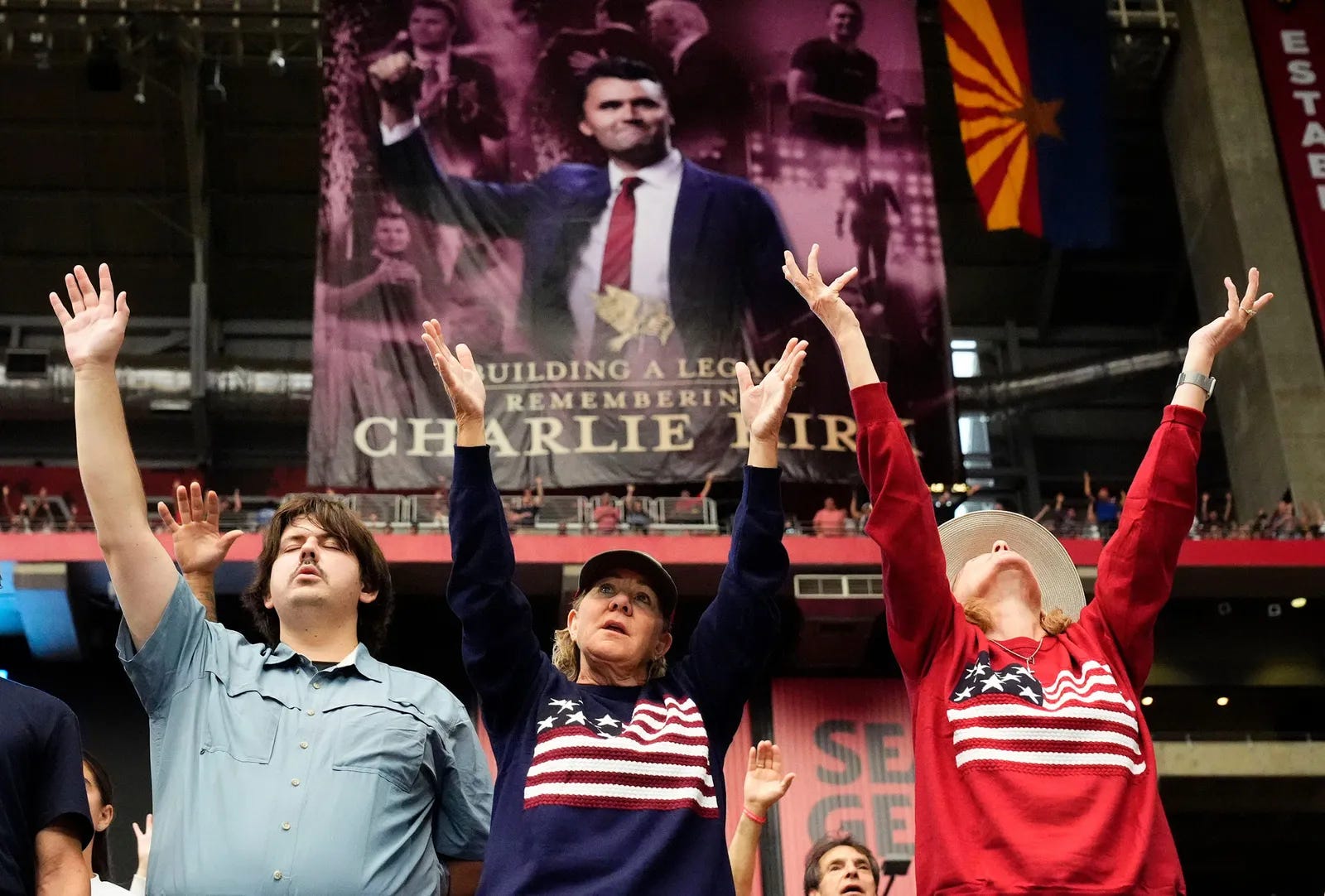
Kirk was assassinated while doing an event on a college campus in Utah. Shot in the neck in front of the world; a level of violence that humans should never witness. It’s violence that radicalizes, especially when the victim is seen as one of your own.
What happened next illustrated the power of Charlie Kirks organization, Turning Point USA. The GOP turned his death and funeral into a state enterprise. The Vice President essentially aligned with the Turning Point organization, as if it was an executive branch initiative. You can see Vance speaking at Turning Point events on the official White House website. Charlie Kirks memorial service was then turned into a political call to action.
In this case, Charlie Kirk’s assassination was the trigger. Kirk spent his career characterizing the downfall of America to the left. He spoke out against the LGBQT community, immigrants, and Muslims. He preached the narrative of our declining society, and promoted Trump’s narrative framing of “making America great again”. The dystopian future was characterized through Democratic policies. “Communism” was coming. Christianity was dying. Yada Yada. This is nothing new to the informed American audience. What’s important is seeing how an American political party and presidency used Charlie Kirk to promote a “turning point”. His death was the trigger, and they used it as justification for retribution. To turn away from the dystopian future, and toward the Christian nationalist alternative.
Spirit
The central premise here is that narrative is propaganda. A weapon of influence that turns people toward extremism. Extremists are open about this. They state the need for narrative framing themselves. Active Club leader Michael Harrington states on Substack:
The nationalist scene is starved for works of fiction and it’s our belief that providing nationalists with fictional works that promote masculinity, heroism, loyalty and sacrifice will do more to transform the movement in the writing sense than 300+ pages of dense political philosophy. - Michael Harrington
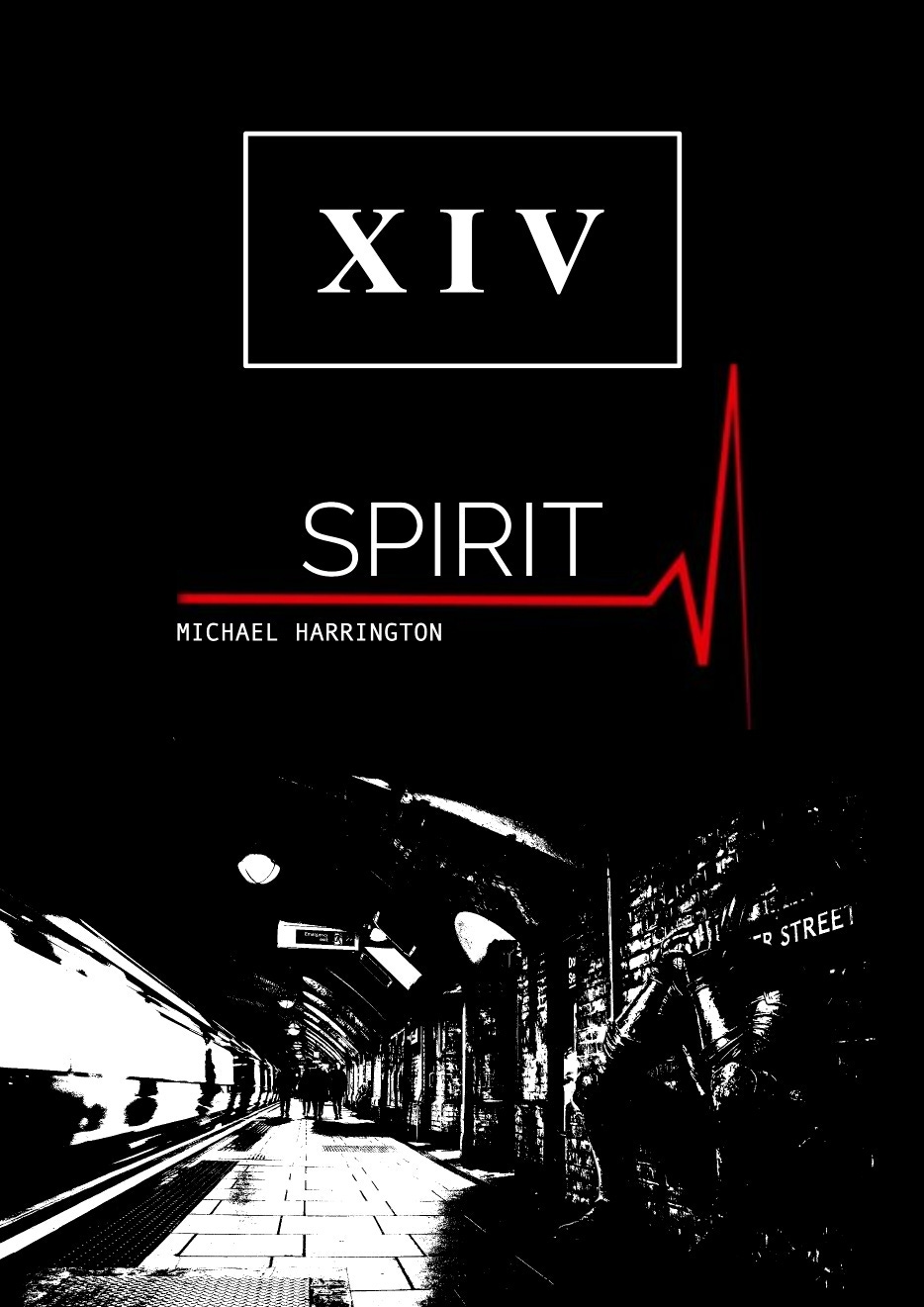
Michael Harrington recently wrote the novel “Spirit”. A fiction specifically targeted toward the nationalist scene, and weaving in nationalist 3.0 themes like “culture thugs” into the story.
Of course, this story follows a familiar blueprint. He virtually states the blueprint himself:
SPIRIT
Set in the not too distant future where the Global Forum for Economics (GFE) has seized absolute power in the West, Spirit is a pulp fiction about how one angry and nihilistic individual of CN-01 (formerly Britain) will come to change and define the lives of many different people in ways expected and unexpected, setting in motion a chain of events that will forever change things directly and indirectly in heroic, tragic, beautiful and frightening ways. - Michal Harrington
Like the Turner Diaries, it’s call to the mythic past is light, and is done through basic mechanisms. Hints at an ideal past, or a longing for the good ol’ days. The Dystopian future is already upon us. Unfortunately, the writing leaves something to be desired, and mixes in all the cliched demonization’s of a pluralist society.
Drinking sessions had become the norm for dealing with the psychosis of the Globalhomo system. It wouldn’t be half bad if there were a healthy balance of male and females that attended but since gender relations collapsed after Fifth Wave Feminism collided with First Wave Male Rights the two sexes don’t really hang out together, except within the family unit, but even then relations are strained. - Spirit, pg 3.
This is the dystopian future on the rise, already causing frustration within the main character, who is essentially primed for a trigger. A trigger that will help fight back and build an ideal white society.
Like the Turner Diaries, the trigger is more explicit in Spirit. The trigger is the main character getting arrested for assaulting a taxi diver. Abused, humiliated, and left on the rural streets to fend for himself by the police, Harry is now primed for radicalization. The setting here hits a lot of far right issues, tightly crammed into a few paragraphs. The criminal as victim due to grievance. A rural urban divide. Race traitors oppressing white people. The narrative plucks away at real world talking points, and places them into the three part narrative structure that is designed to radicalize. The story speaks to the nationalist, because it mirrors the world they are defining for themselves.
The point isn’t literary quality. It’s conditioning. Once you understand the conditioning, you start to see the search for triggers everywhere.
Triggers
The far rights probing of these triggers is consistent. The most significant push toward a trigger has revolved around immigration. It’s the most common theme in right wing politics and nationalism around the world. The white supremacist argument is that immigrants bring crime. They destroy the economy. They bring interracial marriages that erase white people. Their culture turns to law, and western ideals are taken over.
We see this in Active Club street activism, with a common theme being remigration, or the force expulsion of immigrants. We see this in US immigration policy, with, well, remigration. The forced expulsion of migrants, in addition to the harassment, arrest, abuse, and housing in detention facilities around the country. The ideological consistency in white supremacist groups and US immigration policy is high.
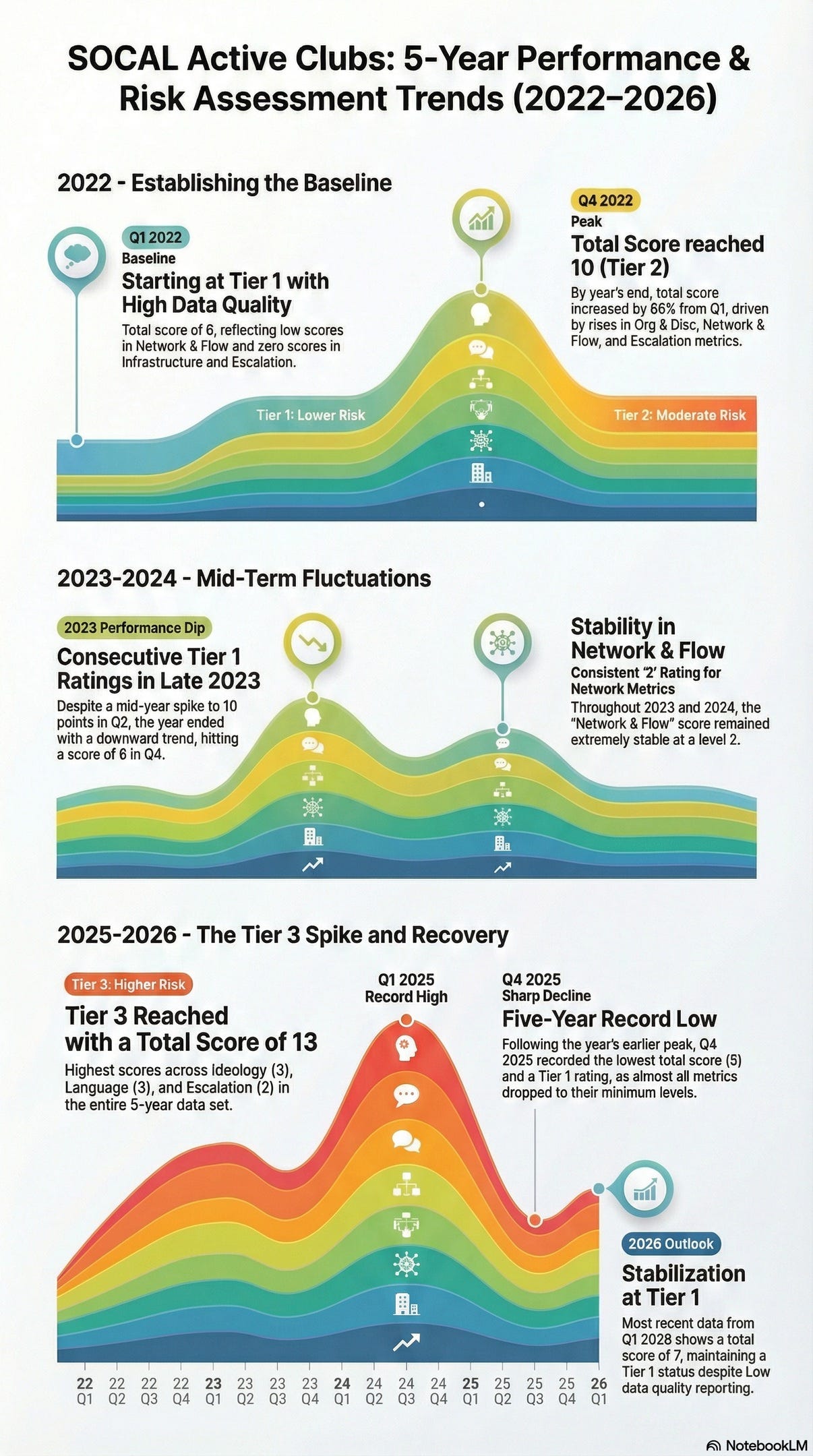
In the image below, you can see from the Active Club assessment of the SoCal Active Club, that fluctuations in scoring revolve around election cycles, primarily driven by communication about anti immigration issues .
Other triggers exist, and usually revolve around crime. The stabbing death of Ukrainian refugee Iryna Zarutska is a common call to action through out nationalist groups. Her image, sitting on a train chair, has become a meme for white supremacy, and is wrapped in all the tropes. Immigrants and minorities murder innocent white women, therefor white men must protect them.
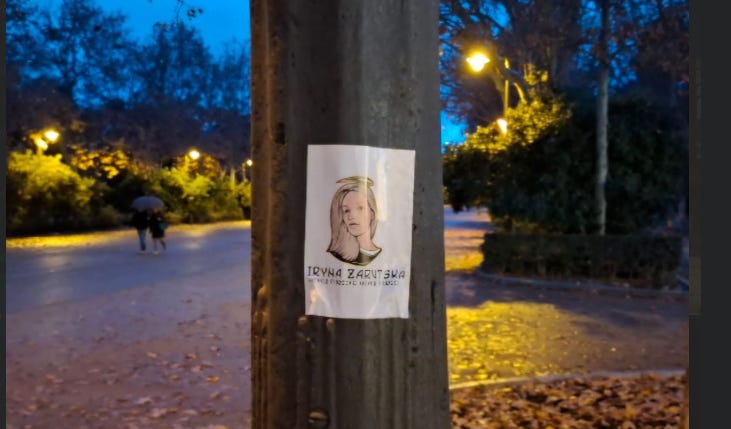
To some degree, this constant search for a trigger never plays out like the novels. A single death hasn’t caused civil war. Yet the constant push continues to radicalize, and as a growing steam of nationalist push for triggers social unrest is more likely. Most triggers fail. The civil war never comes. The uprising never materializes. But the search never stops.
Which brings us back to Lyon, France.
The Trigger and the Martyr
This brings us back to Quentin, the young man who died from injuries sustained in a street brawl between fascists and antifascists in Lyon, France. The story has all the normal hallmarks of a white supremacist worldview. Immigration, “antifa”, women being assaulted, and in this case one of their own murdered and made into a martyr. Martyrs collapse complexity. A street brawl becomes persecution. A political conflict becomes existential threat. Grief becomes mobilization.
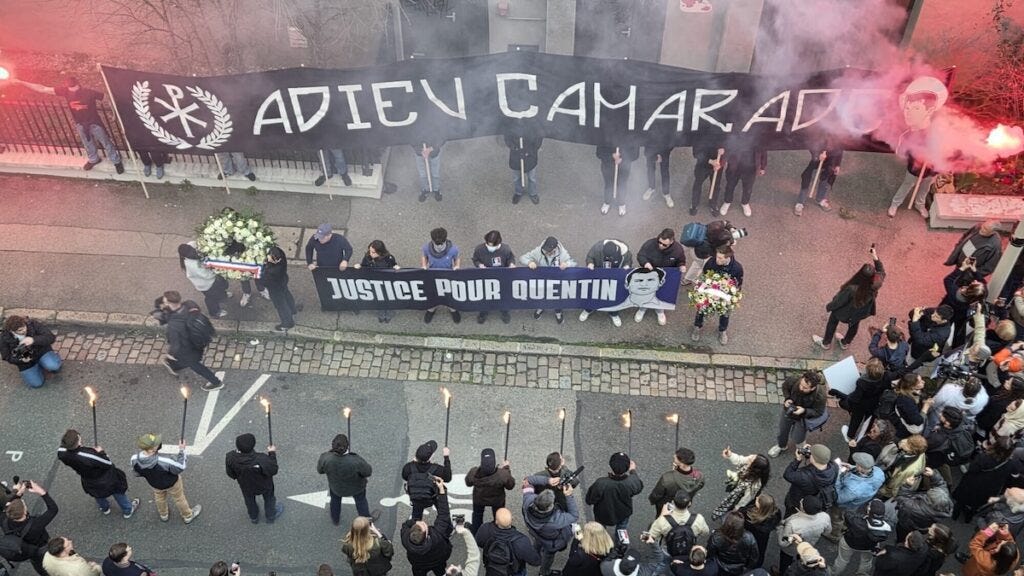
Nationalist channels circulated calls to attend memorials, adopt coordinated dress, and mobilize in Lyon. With a long string of failed triggers, it’s clear this one is being pushed harder than others. Nationalist protests have flared up in Lyon, with national politics in France forced to address the issue. Active Clubs around the world have taken up the cause, using Quentin’s murder as a rallying cry.
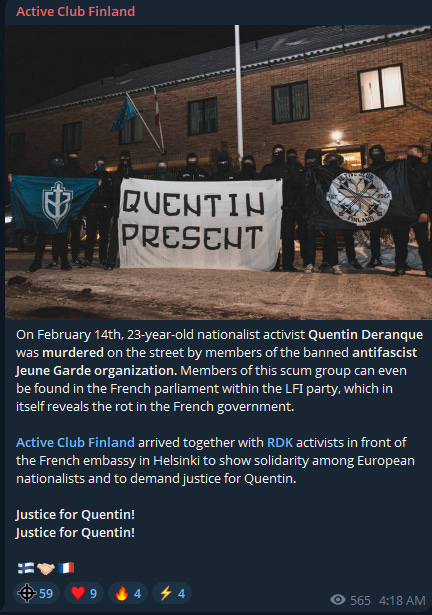
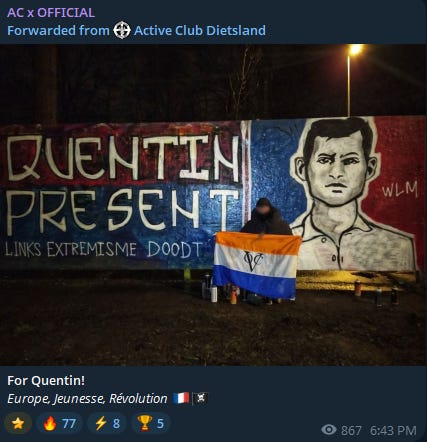
Quentin Deranque’s death is used to characterize the left as violent terrorists. Young men on the right must “tribe up and train” to defend themselves against these leftist groups. Compared to previous incidents, amplification of Quentin’s murder was faster and more coordinated. Pictures of murals, signs, and posters shared across nationalist channels, calling for action.
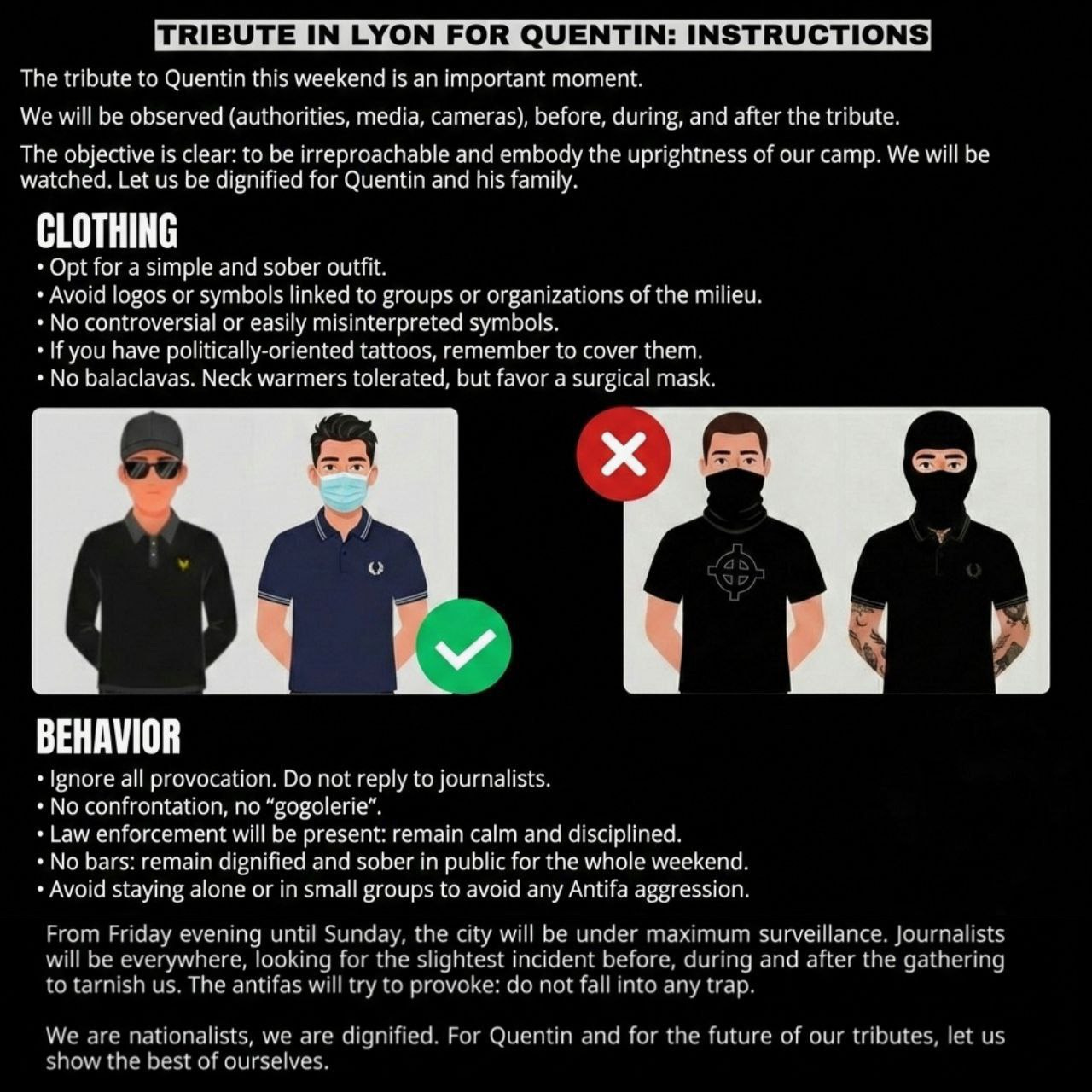
One interesting aspect of this is the role Robert Rundo, the founder of Active Clubs has played in the trigger. Active Clubs are commonly referred to as decentralized. I have previously argued that this is not the case. Robert Rundo runs Active Clubs from the top. Rundo has consistently pushed this trigger with action to his network, and giving explicit instructions on how to dress and show up for Qeuntin’s funeral. The below pic was shared in a core ideological channel, White Lads Aesthetics, with the caption “A attack one of us is a attack on all of us!! Do what you can to attend this, no excuses”. Uniformity at memorial events creates visual cohesion. Visual cohesion produces propaganda imagery. Propaganda imagery reinforces group identity.
One of the strategic purposes of Active Clubs is to get people offline, and develop communities of people that will come together. Low level ‘street action’ functions as rehearsal. It builds familiarity, hierarchy, and shared risk. Things that seem innocuous have stated strategic goals. Build hierarchy. Get men on the streets fighting for a cause. Get them ready for real conflict as ideological leaders constantly scan world news channels for events to transform into triggers.
The trigger is not just an event, it is framed as proof of the narrative the extremists have already been telling. If the narrative is right about this, it must be right about everything. The dystopian future, the glorious past, and the need to act before it’s too late
There are currently protests happening in France by groups of nationalists supporting Quentin Deranque. These protests represent an attempt to convert narrative into mobilization. The trigger is used to radicalize and mobilize, and the resulting images are propaganda used to project power.
Deconstructing Narratives
Understanding the three part narrative structure is important to understanding the nationalist scene. It informs their behavior, when there are threats, and when they are escalating. My hope in outlining white supremacist narrative structures is that it serves as a pre-bunking tool. An inoculation from the effective narrative strategy used for so long. The more people that can spot radicalization, the more that we can keep people from succumbing to it. If you can see the narrative structure forming in real time, then you can refuse the trigger.
Do you have information regarding extremist in the martial arts space? Contact me at SubmittingDisinfo@ProtonMail.com